

Every few years, scenario planning gets rediscovered. Geopolitical shocks, pandemic disruptions, AI upheaval — something breaks through the fog of quarterly optimism and executives suddenly want to talk about futures again. Consultants get called. Workshops get booked. Narratives about possible worlds get written on large sticky notes.
And then, quietly, nothing changes.
A new paper in MIT Sloan Management Review by Paul Schoemaker and Shardul Phadnis puts its finger on exactly why. Their diagnosis is precise: scenario planning fails not because the method is flawed, but because organisations treat it as an event rather than a capability. A workshop, not a way of thinking. A deliverable, not a discipline.
They’re right. But I want to push their argument one step further — to a place the paper only gestures toward.
The real problem isn’t that organisations lack the right processes around scenario planning. It’s that the people running those organisations were never taught to think in scenarios in the first place.
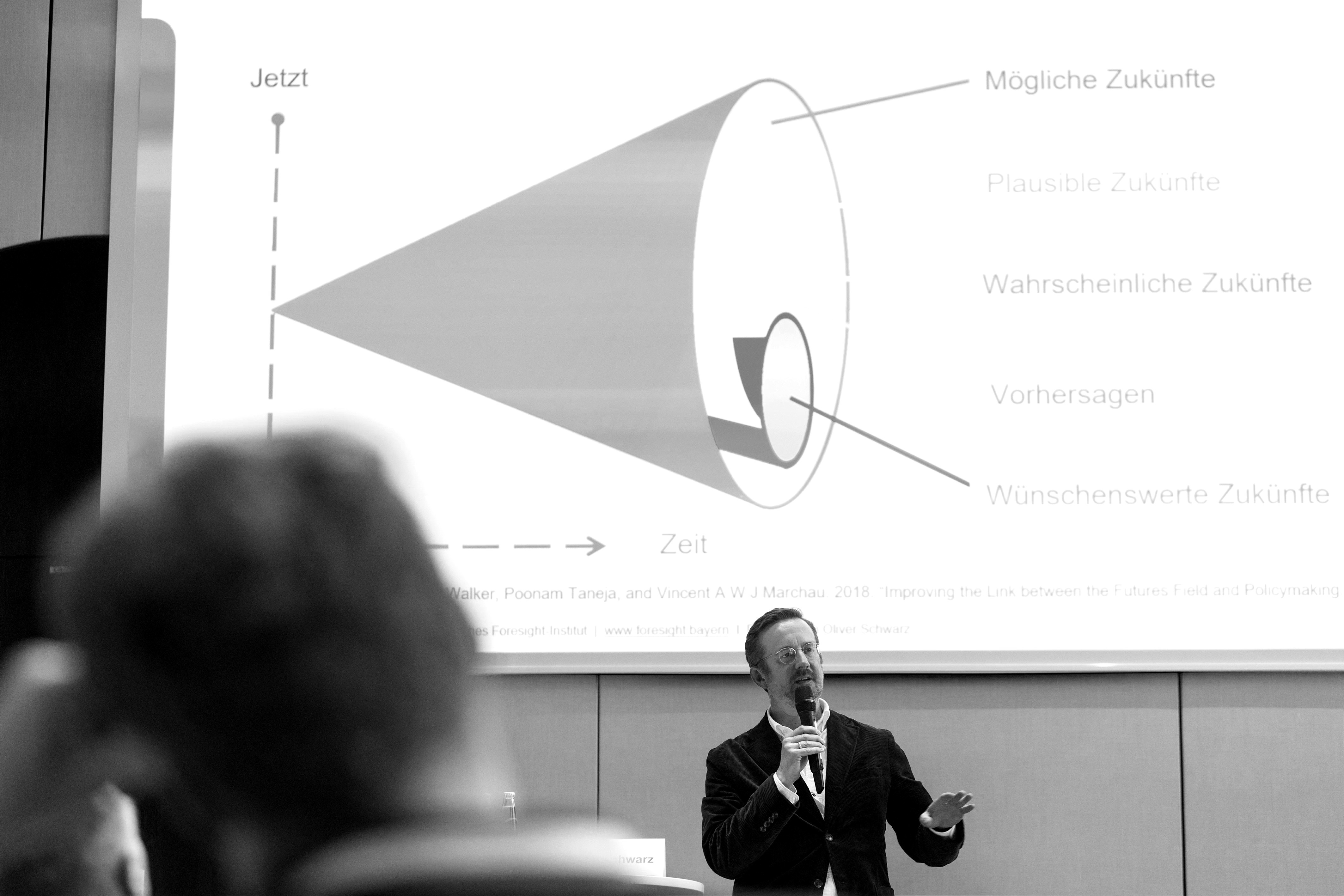
(Picture: ®Goran Gajanin – DAS KRAFTWERK)
When the Tool Lands in the Wrong Hands
Schoemaker and Phadnis open with a story that should embarrass the field. Shell’s earliest scenario work, circa 1970, produced prescient analysis of global energy futures — including a scenario that anticipated the oil price tripling after the Arab-Israeli War in 1973. It was ignored. Not because it was wrong. Because it was produced by a small group of central planners who hadn’t brought senior leadership into the thinking.
The lesson Shell drew was critical: scenarios that leaders don’t co-create, leaders won’t use. Ownership precedes impact.
A second example is equally telling. A major U.S. transportation company ran a scenario exercise on the future of electric trucking. The work was good. But the senior engineers in the group were reluctant to present their findings to the C-suite — because the scenarios “felt overly speculative.” As one put it: “We are trained to argue our case with evidence and data.”
Read that again. These were senior professionals who had just done serious foresight work — and they didn’t trust themselves to defend it, because nothing in their training had prepared them to think or communicate in terms of plausible futures rather than probable ones.
This is the gap. Not a process gap. A mindset gap.
The Six Levers — and the One That’s Missing
Schoemaker and Phadnis propose a six-element framework for making scenario planning stick: external scenarios, adaptive strategies, dynamic monitoring, organisational agility, decision-making savvy, and strong leadership. It’s a solid architecture. Each element is well-argued, and the framing — analogising the system to how pilots navigate uncertainty — is genuinely useful.
But notice what’s implicit across all six: they all require leaders who are already comfortable with ambiguity. Leaders who can hold multiple futures simultaneously without collapsing into false certainty. Leaders who know what a “weak signal” looks like before it becomes a crisis. Leaders who understand the difference between risk (where probabilities exist) and uncertainty (where they don’t).
These are not natural cognitive defaults. They are learned capacities. And right now, they are largely untaught.
Business schools still train people to optimise. Strategy courses still default to single-point forecasts. Leadership programmes still reward decisiveness over epistemic humility. The mental models that scenario thinking is designed to disrupt are the very mental models that formal management education systematically reinforces.
What Leadership Education Gets Wrong About the Future
Ask yourself: in how many executive education programmes does a leader spend serious time inhabiting a future that contradicts their current strategy? In how many MBA curricula does uncertainty get treated as the norm rather than the noise to be eliminated? In how many leadership development journeys is “tolerating ambiguity” treated as a core competency rather than a personality trait some people happen to have?
The answers, broadly, are: not many, very few, and almost none.
This matters enormously. Because the authors are correct that scenario planning requires “farsighted leadership” — but farsighted leadership isn’t just a disposition. It’s a set of cognitive and conversational skills that can be developed. The ability to think in multiple futures. To recognise when you’re anchoring on a single trajectory. To ask “what would have to be true for the opposite to happen?” To surface assumptions before they harden into strategy.
These skills are teachable. They are simply not being taught — at least not systematically, not early enough, and not as a core part of what it means to lead.
Scenario Thinking as Leadership Literacy
Here is the proposition I want to put to you: scenario thinking should be treated as a fundamental literacy for leadership, in the same way that financial literacy or communication skills are.
Not scenario planning as a technique deployed occasionally by strategy teams. But scenario thinking as a habitual mode of reasoning that leaders bring to every significant decision — about investments, about talent, about market positioning, about organisational design.
This means something concrete for how we educate leaders:
Earlier exposure. Scenario thinking should enter leadership development programmes long before someone is sitting in a C-suite. The cognitive habits need time to form. A one-day workshop at age 52 will not undo thirty years of single-forecast conditioning.
Integration, not isolation. Foresight methods should not live in a silo labelled “strategy.” They belong in finance discussions (what are the scenarios for this capital allocation?), in people decisions (what future are we hiring for?), in operational planning (what are our adaptive options here?). Schoemaker and Phadnis describe the connective tissue between scenario planning and other organisational processes. Leadership education needs to build that connective tissue in individuals first.
Reframing uncertainty. Most leaders are implicitly trained to treat uncertainty as a problem to be resolved before action can be taken. Scenario thinking inverts this: uncertainty is the condition of leadership, not an obstacle to it. Intel’s Andy Grove, quoted in the paper, got it right — “Give me a turbulent world as compared with a stable world and I’ll want the turbulent world.” That orientation needs to be cultivated, not assumed.
Practice, not just exposure. Scenario exercises work as learning tools when they are genuinely uncomfortable — when they force leaders to take seriously a future they instinctively disbelieve. The dress rehearsal metaphor that Schoemaker and Phadnis use is apt: pilots don’t learn crisis response by reading about it. Neither do leaders.
The Institutional Challenge
None of this is easy to institutionalise. Business schools face their own pressures — rankings, placement rates, student expectations shaped by job markets that still reward technical optimisation over strategic wisdom. Executive education programmes are constrained by the time their participants can afford to spend away from the office.
And there is a subtler resistance. Scenario thinking requires leaders to publicly entertain possibilities they may not believe in — including scenarios in which their current strategy fails. This demands a certain intellectual courage and psychological safety that many organisations do not provide and many leadership cultures actively suppress.
But this is precisely why it needs to become structural rather than optional. When it’s left to individual curiosity, only the already-curious benefit. When it’s embedded in how leaders are developed, it becomes a shared organisational capacity — which is, ultimately, what Schoemaker and Phadnis are arguing organisations need.
What I’m Watching
A few things give me cause for cautious optimism.
The volatility of the last five years has made it harder for organisations to pretend that single-point forecasting is adequate. Leaders who lived through COVID, the subsequent supply chain disintegration, and the acceleration of AI have experienced, in visceral terms, what it means to be unprepared for a world that departed sharply from the baseline. In our research we have seen an uptake of corporate foresight activities.
And there is a growing body of evidence, including work by Schoemaker and colleagues, that scenario exercises actually do shift expert judgment — that exposing decision-makers to multiple futures leads to more flexible investment thinking and more robust strategies. The method works. The question is whether the institutions responsible for developing leaders will take it seriously enough to teach it.
The Bottom Line
Schoemaker and Phadnis have written a rigorous and useful paper. Their six-element framework is a genuine contribution to the question of how organisations can make scenario planning more than a one-time event. Read it.
But the argument I want to make — and the argument I’ll keep making in this newsletter — is that process reform inside organisations will only go so far if the leaders running those organisations haven’t developed the underlying cognitive capacity to think in futures.
Scenario planning needs to stick not just in strategy departments. It needs to stick in minds. And that is, fundamentally, an education problem.
The paper discussed in this issue: Schoemaker, P.J.H. & Phadnis, S.S. — “How to Make Scenario Planning Stick,” MIT Sloan Management Review, Winter 2026.
been reading a piece this week making basically the opposite case, that you should refuse to predict at all and just add what you prove you need as you go. https://sive.rs/fit now not sure which instinct is actually right.